
This site is reader-supported. As an Amazon Associate we earn from qualifying purchases. When you buy through links on this page, we may receive an affiliate commission at no additional cost to you. Our editorial picks are independent of commercial relationships.
What Makes a Fountain Pen a Good Budget Buy
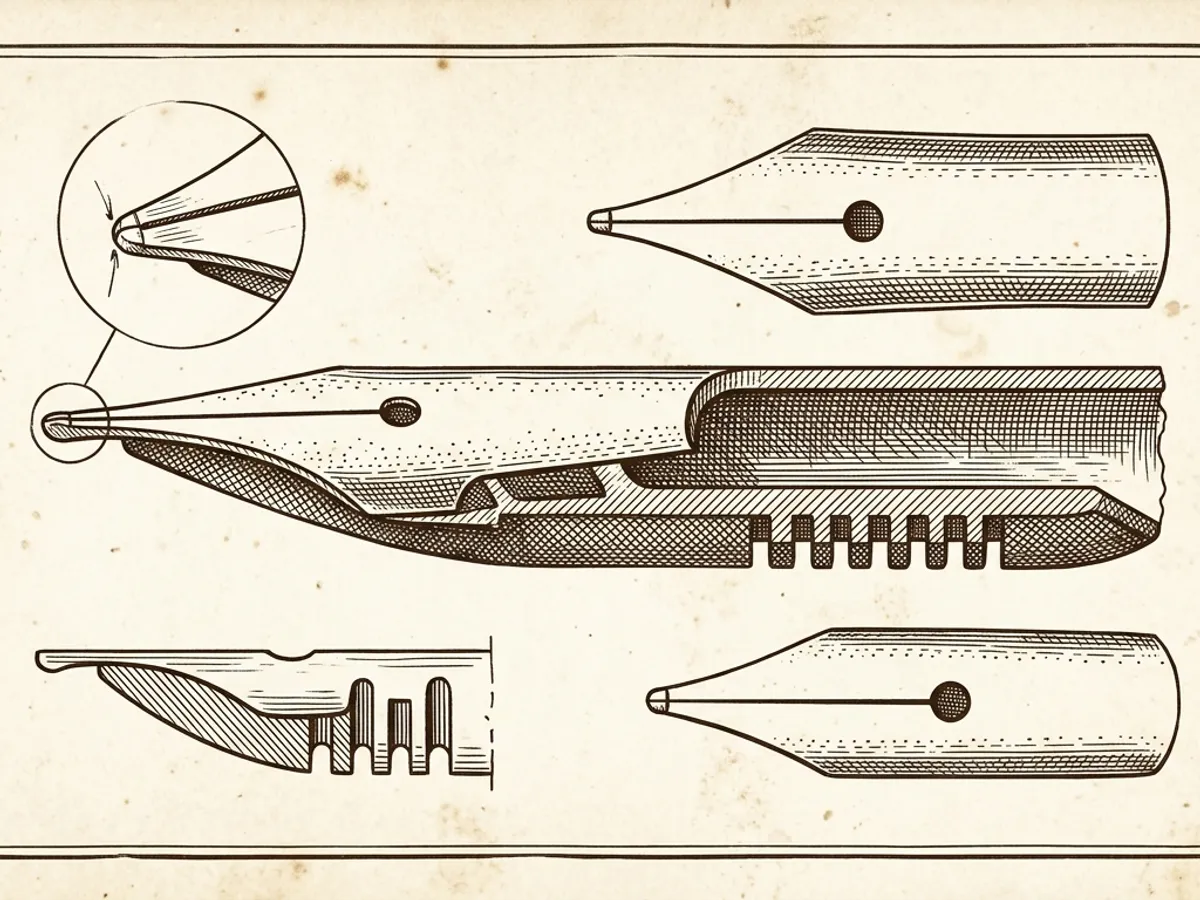
Not every inexpensive fountain pen writes well. The budget category spans everything from sub-dollar novelty items that scratch instead of glide to mid-range workhorses that enthusiasts carry alongside pens costing ten times as much. Understanding what separates a genuinely good budget fountain pen from a frustrating one saves you money and a lot of disappointment.
Nib quality at the factory. A fountain pen nib is the split metal tip that controls ink flow onto the page. When a nib leaves the factory well-tuned — tines aligned, gap consistent — it writes smoothly from day one. A poorly tuned nib skips, starts hard, or feels scratchy on paper, and none of that has anything to do with the pen’s price. The manufacturers covered below maintain consistent factory quality, meaning the nib that arrives at your door is almost always ready to write without adjustment.
Ink system simplicity. Budget pens are used by people who want to write, not tinker. The best budget options work reliably with their matching ink cartridges straight out of the box, with no priming, no flushing, and no fumbling.
Cartridge and converter compatibility. Before buying, it is worth understanding that ink systems are not universal. Different manufacturers use different proprietary formats:
- Pilot uses its own cartridge system. These are widely available and work well, but they only fit Pilot pens.
- Platinum uses its own proprietary cartridge format. Platinum cartridges only fit Platinum pens.
- Kaweco uses the standard international cartridge format, which is shared by dozens of ink brands worldwide — giving you immediate access to hundreds of colors without being tied to a single manufacturer’s lineup.
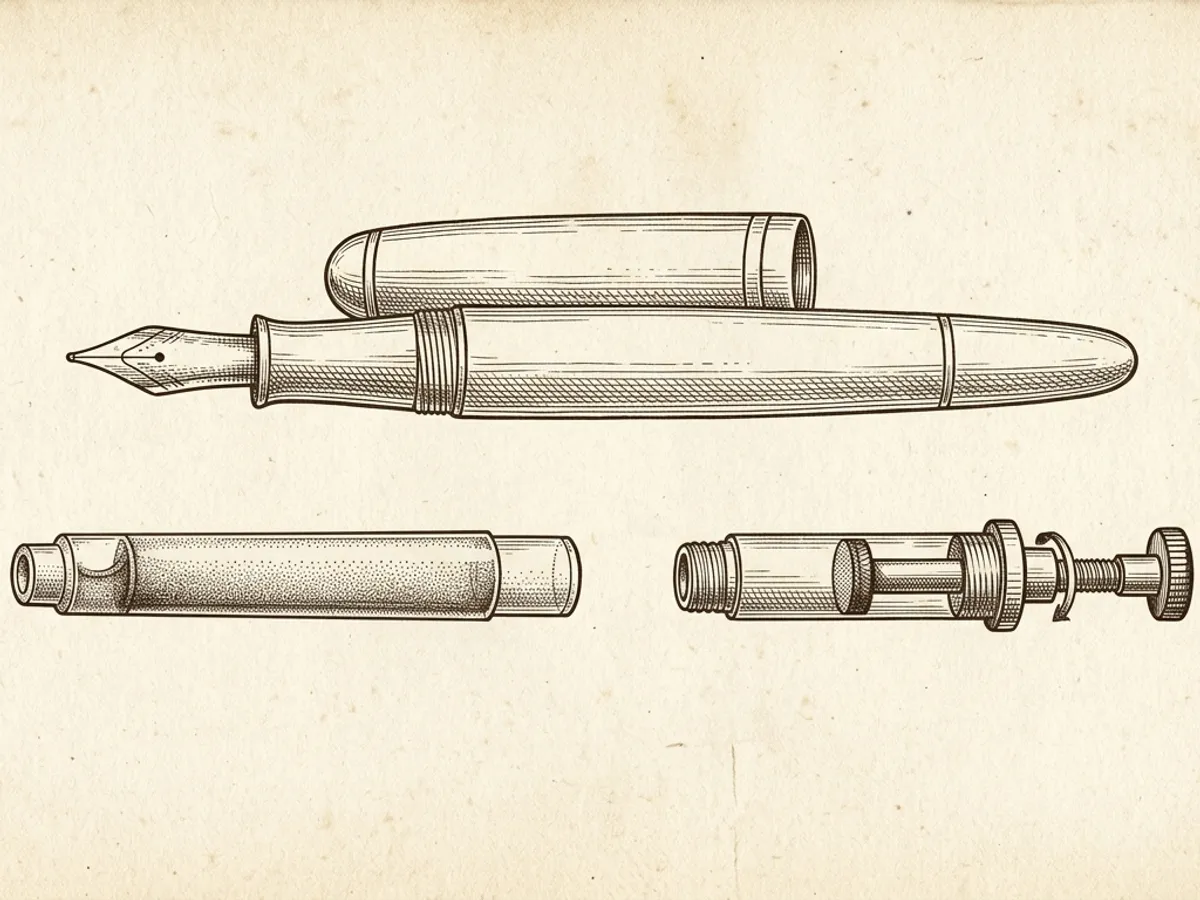
- TWSBI pens like the Eco use a built-in piston mechanism and fill directly from a bottle, with no cartridges at all.
Build quality relative to price. Budget pens can be plastic, metal, or a combination. Plastic is not inherently worse — many favorites in this category use lightweight ABS that survives drops without cracking. What matters is whether the cap seals properly to prevent the nib from drying out, whether the section threads or press-fits together securely, and whether the clip holds up to daily use.
Price Tiers and What to Expect
A budget fountain pen does not have to be a compromise. Several options in this category write better than pens at three or four times the price. The sweet spot is not necessarily the cheapest option available — it is the pen that gives you the most writing pleasure for the money. The four pens below cover a range from ultra-affordable to modest mid-range, each representing genuine value at its price point.
The Best Budget Fountain Pens
The four pens below are among the most recommended budget fountain pens in fountain pen communities, and each has been on the market long enough to have a well-established reliability record. Any one of them delivers a real fountain pen writing experience.
Platinum Preppy — Best Ultra-Budget Pick
The Platinum Preppy answers the question: what is the least you can spend to get a real fountain pen that actually writes well? At its price there is simply no competition. The nib — particularly in the fine (F) and extra-fine (0.3mm) sizes — is sharper and more consistent than many pens at double or triple the cost. The transparent barrel lets you see exactly how much ink remains, which is a practical touch rarely found at this price.
The Preppy uses Platinum’s proprietary ink cartridges. One standout feature is what Platinum calls Slip and Seal technology: an airtight inner cap mechanism designed to prevent the nib and feed from drying out even when the pen sits unused for weeks. For a budget pen that might not be in daily rotation, this is a genuine practical advantage. A Preppy you set aside on a Tuesday is typically ready to write the following Monday without any coaxing — a notable contrast to less carefully designed caps.
The body is lightweight plastic. It is not going to feel like a luxury object, and it is not meant to. What it is, precisely, is the lowest-risk way to find out whether fountain pen writing suits you. If you buy one and discover that you prefer ballpoints, you have lost very little. If you enjoy it, the upgrade path to one of the pens below is natural and motivated.
The fine and extra-fine nibs are the strengths of the Preppy lineup. If you write very small, annotate dense text, or use narrow-ruled paper, the Preppy in 0.3mm outperforms most pens at any price for that specific task.
View the Platinum Preppy on Amazon
Pilot Kakuno — Best Fun Daily Writer
The Pilot Kakuno is Pilot’s deliberately lighthearted entry-level pen — and it is, without exaggeration, one of the best nibs available in the budget category. The nib is factory-tuned to Pilot’s consistently excellent standards: smooth, reliable, and wet enough to start easily even after the pen has been left uncapped for several seconds. The small smiley face stamped on the nib is either charming or irritating depending on your sensibility, but the writing performance is the same either way.
The Kakuno’s hooded section design — where the nib edges are recessed into a protective housing — makes it particularly forgiving for writers who hold their pen at inconsistent or shallow angles. This is the pen that fountain pen communities most commonly recommend to children and teenagers learning to write with a fountain pen, but the nib quality makes it well worth considering for any adult who wants a reliable, no-fuss daily writer.
The Kakuno uses Pilot’s proprietary cartridges (available in short and standard lengths) and is compatible with Pilot converters for those who want to use bottled ink. Neither the cartridges nor the converters are interchangeable with other brands.
The Kakuno is available in medium (M) and fine (F) nib sizes in most markets, with a broad (B) available in some regions. The medium is the most popular and is an excellent all-rounder for everyday writing.
View the Pilot Kakuno on Amazon
Kaweco Perkeo — Best Versatile Budget Kaweco
The Kaweco Perkeo is Kaweco’s take on a full-body, affordable everyday pen. It is noticeably larger than the compact Kaweco Sport that most people associate with the brand — the Perkeo writes comfortably at full length without posting the cap — making it a better fit for writers who find the Sport too short.
The critical advantage of any Kaweco pen for a budget buyer is the standard international cartridge system. Standard international cartridges are manufactured by Diamine, Caran d’Ache, Pelikan, Faber-Castell, and dozens of other brands. From the first day you own a Kaweco Perkeo, you have access to hundreds of ink colors across a wide price range, without being tied to a single manufacturer’s limited cartridge selection. The Perkeo also accepts standard international converters, allowing direct filling from a bottle.
The nib is a steel unit that writes consistently for a pen at this price. Build quality is solid ABS plastic with a clean, modern design. The cap posts securely on the back of the barrel. The pen is lightweight — some writers find this comfortable; others find it insubstantial. If you prefer a heavier pen, both the Pilot Metropolitan and the Pilot Kakuno have metal or metal-reinforced construction.
The Perkeo is available in fine (F) and medium (M) nib sizes in most markets. Medium is the safe starting choice for most writers.
View the Kaweco Perkeo on Amazon
TWSBI Eco — Best Value Piston Filler
If your goal is a fountain pen that fills directly from a bottle of ink — no cartridges, no separate converter — the TWSBI Eco is the obvious recommendation at its price. It is a transparent demonstrator pen (you can see the ink inside the barrel as you write) with a built-in piston mechanism that draws ink straight from a bottle in one smooth operation.
The Eco’s ink capacity far exceeds what any cartridge or small converter can hold. Writers who go through ink quickly — journaling daily, writing long letters, taking dense notes — will refill far less often than with a cartridge pen. The ink chamber is also easy to flush and clean, which matters when you want to change colors.
The nib is consistently good across the range: smooth, well-tuned, and available in more size options than most budget pens — EF, F, M, B, and stub. The stub nib is popular for writers who want some line variation in everyday handwriting without committing to a full italic. TWSBI also sells replacement O-rings for the Eco, which means the pen can be serviced and maintained indefinitely.
The trade-off: the Eco is a piston filler only. You fill it from a bottle or you don’t fill it. This is only a constraint if you travel frequently or need the option of a backup cartridge. The piston also requires occasional maintenance — if you store the pen full for months without use, the ink can dry around the O-rings and stiffen the piston. Flushing with cool water resolves this, but it is worth knowing before you buy.
Choosing Your Nib Size
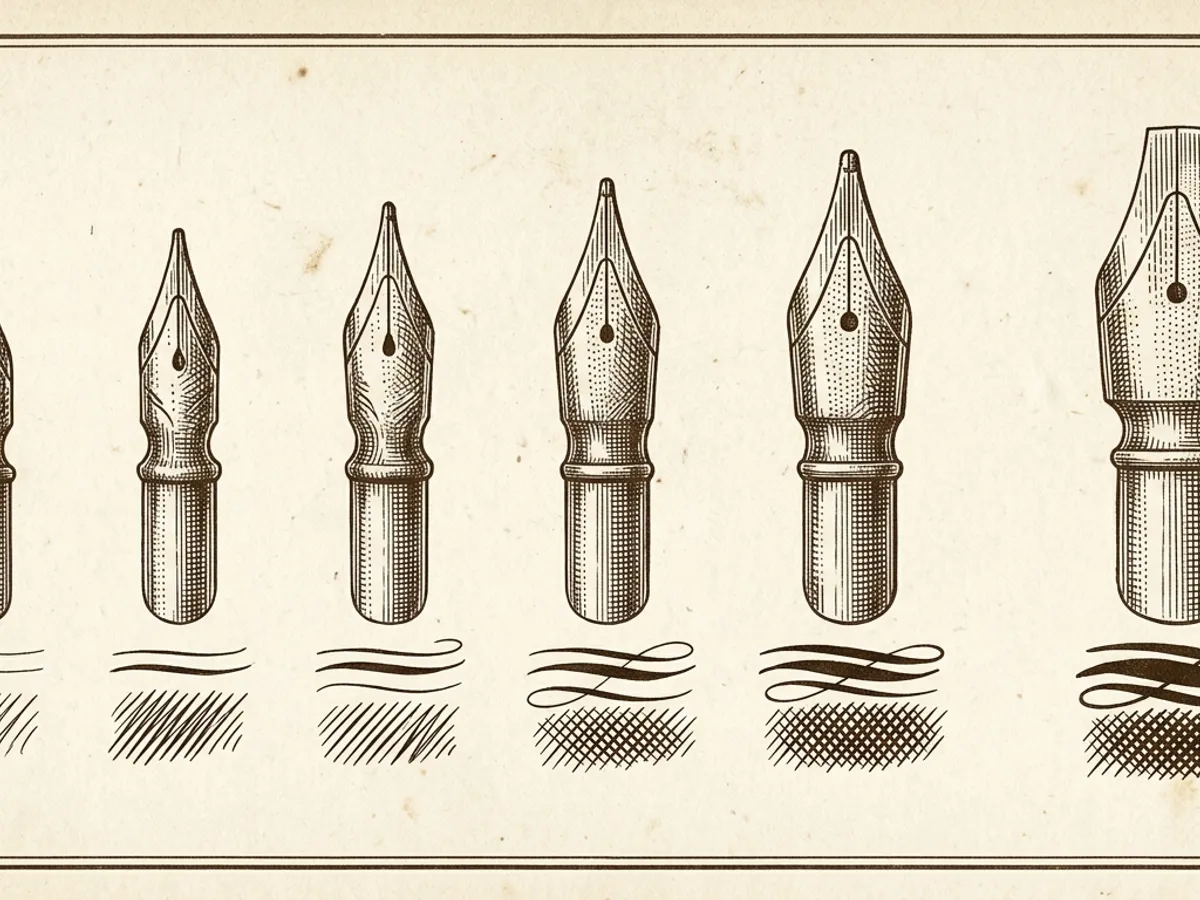
Nib width affects both how your writing looks on the page and how forgiving the pen is across different paper types. The right size depends on your handwriting scale, the paper you use most, and the kind of line you enjoy.
Extra-fine (EF): The narrowest commonly available option. Best for very small handwriting, dense note-taking, and precise annotation. EF nibs are less forgiving on rough or absorbent paper — feathering and bleed-through that a wider nib handles gracefully can become real problems. The Platinum Preppy 0.3mm and TWSBI Eco EF are both strong options at this end of the range.
Fine (F): A versatile choice for writers with small-to-average handwriting. Fine nibs work well on a broad range of paper without the paper sensitivity of extra-fine. Most of the pens above are available in fine.
Medium (M): The practical default for most adults. Medium nibs are wet, smooth, and tolerant of minor inconsistencies in writing angle and paper quality. If you are not sure which size to start with, medium is the safe answer for most people writing on typical office or notebook paper.
Broad (B): A wide, expressive line that suits large handwriting or calligraphic writing. Broad nibs are more prone to feathering on absorbent paper. If you want a broad nib, pair it with smoother paper from the start.
Stub: A nib ground flat rather than rounded, producing wider horizontal strokes and narrower vertical ones — the foundation of italic-style writing. The TWSBI Eco stub is one of the most accessible entry points for writers curious about this style. Stubs require more attention to writing angle than a standard round nib.
A Note on Japanese Versus European Nib Sizing
Japanese manufacturers — Pilot and Platinum among them — tend to run roughly a half-size finer than European equivalents labeled the same way. A Pilot Fine writes closer to a European Extra-Fine in actual line width. If you are switching from a European medium to a Pilot pen, consider trying the medium to match what you know; if you are switching from a European fine to a Pilot, expect a noticeably narrower line than you may be used to.
Making the Most of a Budget Pen
The pen itself is only part of the story. How you care for it and what you pair it with makes a substantial difference in writing quality and how long the pen stays in good condition.
Use it regularly. Fountain pens stay in better condition with regular use. Daily writing keeps ink flowing freely through the feed channels and prevents the kind of slow drying that leads to hard starts. If you know you won’t use a pen for more than a few weeks, flush it, dry it, and store it empty — or choose a pen with an effective cap seal, like the Platinum Preppy.
Choose paper that suits fountain pen ink. Many fountain pen writing problems are paper problems. Standard copy paper and inexpensive notebooks are highly absorbent, causing feathering (ink spreading along paper fibers), bleed-through, and a scratchy writing feel as the nib catches on loose fibers. Papers designed for fountain pen use — Rhodia, Clairefontaine, Leuchtturm1917, and Midori MD are all widely available and reasonably priced — make every pen in this category write noticeably better. If your new pen writes badly on one paper but well on another, change the paper before adjusting anything else.
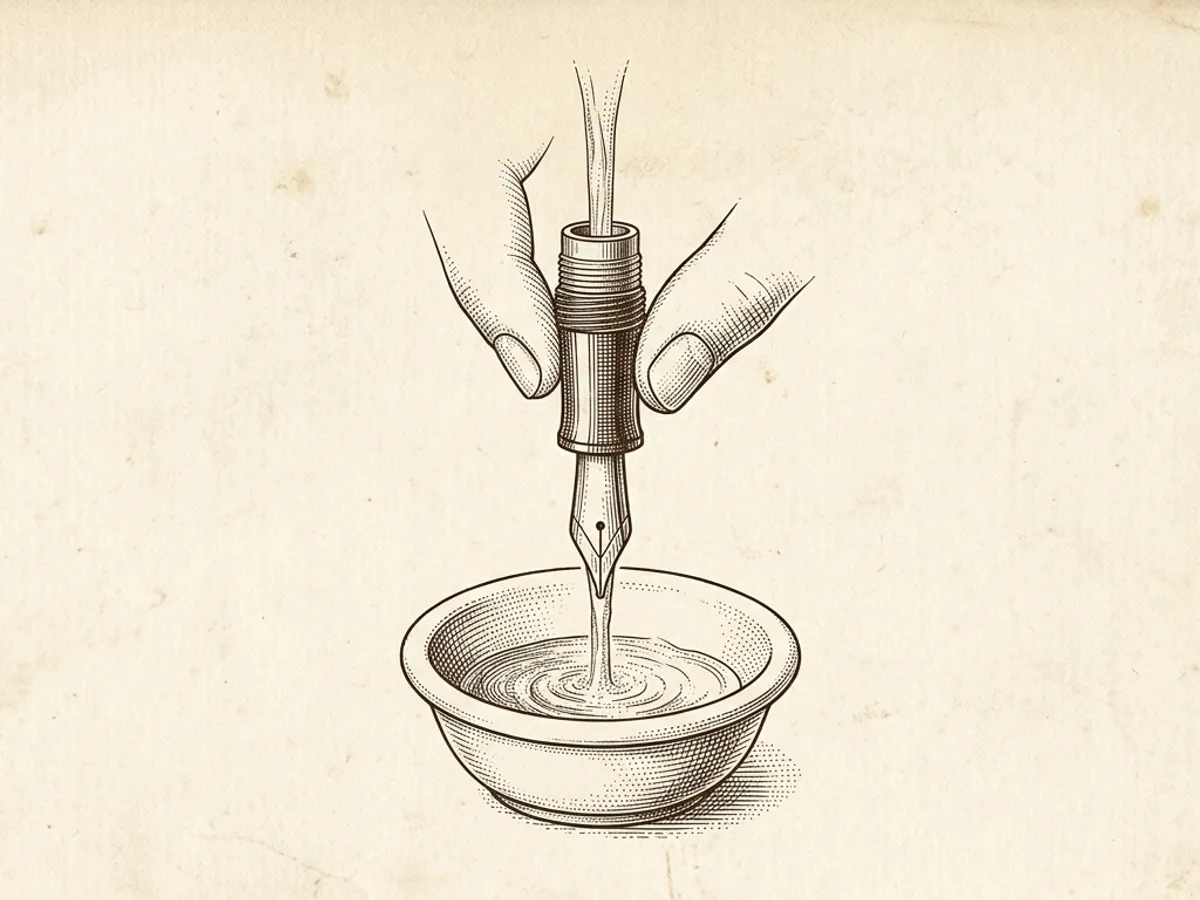
Flush when changing inks. Running cool water through the pen when switching ink colors prevents unwanted mixing and the potential for chemical interactions between inks that could clog fine channels. For cartridge pens, remove the used cartridge and flush water through the section until it runs clear. For piston fillers like the TWSBI Eco, draw in and expel water several times.
Use only fountain-pen-safe inks. India ink, traditional calligraphy inks, and most pigmented drawing inks will clog the narrow feed channels of a fountain pen and are very difficult to clear. Use only inks labeled as fountain pen safe. Widely available, consistently safe brands include Diamine, Waterman, Pelikan Edelstein, and Lamy ink.
Store nib-down or horizontal. Storing a capped fountain pen nib-up for extended periods can cause air to work its way into the feed, leading to hard starts. Nib-down or horizontal storage keeps ink at the feed and ready to write.
Frequently Asked Questions
Is a budget fountain pen worth buying if I’ve never used one?
Yes — it is often the better starting point. A budget pen that writes well lets you find out whether the format suits you without significant financial risk. The Platinum Preppy in particular is the standard community recommendation for anyone unsure whether they want to commit to fountain pens.
Can I use any fountain pen ink in these pens?
Any ink labeled fountain pen safe is appropriate. The compatibility caveat is the important one: Pilot cartridges only fit Pilot pens, Platinum cartridges only fit Platinum pens. Kaweco and TWSBI (via standard international converter) accept cartridges and converters from many brands. Check the ink system notes in each pen section above before buying cartridges or bottled ink.
How often will I need to replace cartridges or refill?
Writing volume and nib width both affect this. A medium nib used for several pages a day might exhaust a standard cartridge in one to two weeks. The TWSBI Eco’s larger piston reservoir lasts much longer between fills. If ink cost matters, a piston filler or a converter-equipped pen using bottled ink costs significantly less per milliliter than buying individual cartridges over time.
My new pen arrived and is not writing. What should I try?
The most common cause is a cartridge seal that did not fully break. Press the cartridge firmly onto the feed until you feel a distinct pop, then hold the pen nib-down and wait a minute or two. If it still does not write, tap the capped pen gently nib-down on a table several times to coax ink forward by gravity. For a broader troubleshooting guide covering hard starts, skipping, and flooding, see How to Fill a Fountain Pen With Ink.
Will a budget pen last?
With basic care — regular use, flushing when switching inks, avoiding drops — a budget fountain pen can last years. The Platinum Preppy is designed with durability and an airtight seal in mind. TWSBI sells replacement O-rings and seal grease for the Eco, so the pen can be serviced indefinitely. The biggest threat to any budget pen is storage while full of ink for months without use, which can dry the mechanism. Empty and flush before long-term storage and they will last.