
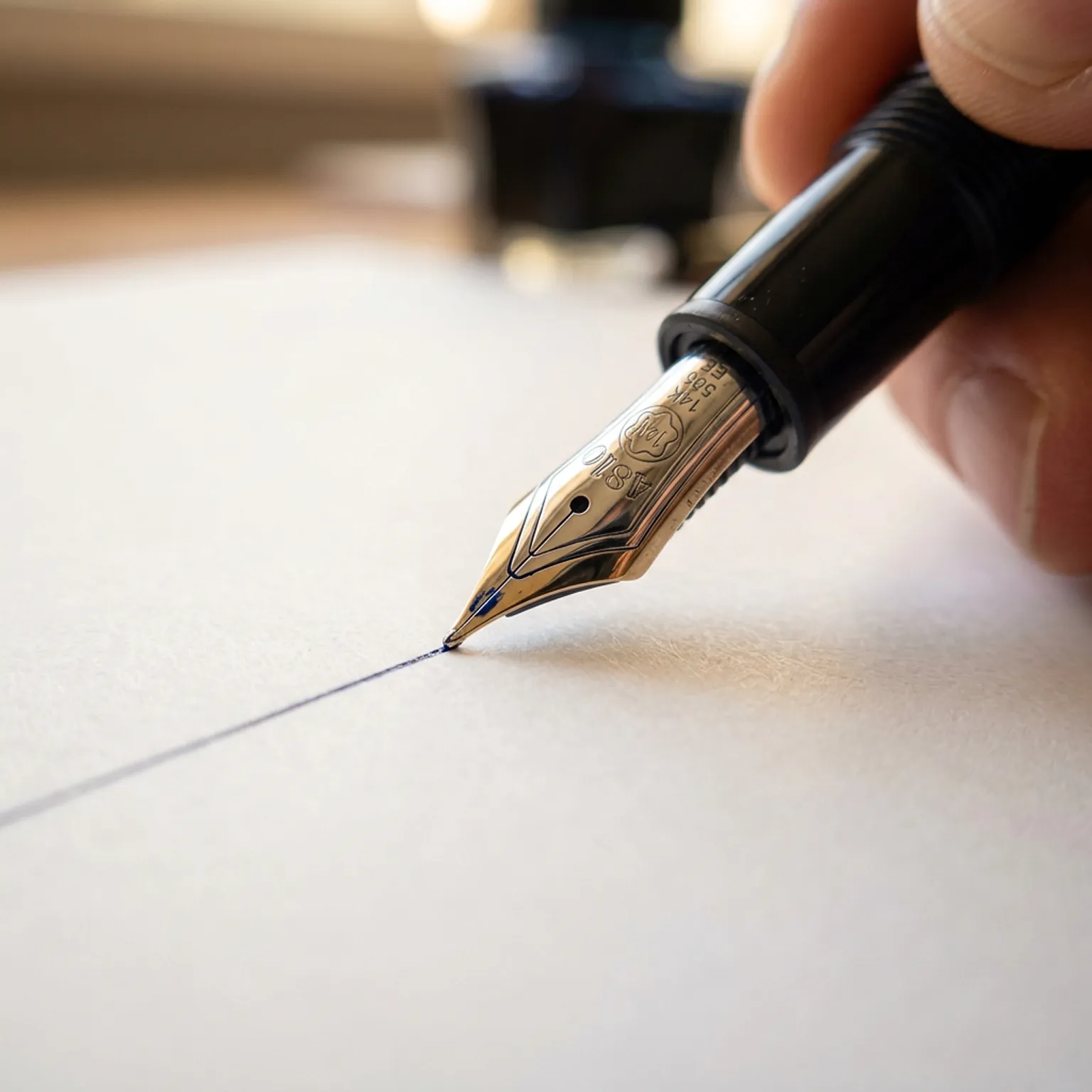
This site is reader-supported. As an Amazon Associate we earn from qualifying purchases. When you buy through links on this page, we may receive an affiliate commission at no additional cost to you. Our editorial picks are independent of commercial relationships.
Who Should Choose an Extra Fine Nib
An extra fine nib is the right tool for specific writing situations. Understanding those situations before you buy prevents one of the most common fountain pen disappointments: the feeling that a pen “writes badly” when the real problem is a mismatch between nib size and use case.
Extra fine nibs suit four kinds of writers particularly well.
Writers with small, compact handwriting. If your natural letter height is consistently small — below around 4 to 5 millimeters — a medium or broad nib fills those letterforms with ink and causes adjacent strokes to merge. An extra fine nib keeps individual letters distinct even at small scale. This matters practically for anyone who fills standard spiral notebooks, takes dense academic notes, annotates margins, or writes in small-format journals.
Anyone who works on narrow-ruled or grid paper. Standard ruled paper has lines 8mm apart; narrow-ruled paper drops to 6.5mm. On that narrow spacing, a medium nib’s line occupies a noticeable portion of the available space. An extra fine nib sits comfortably within the ruling without crowding.
Technical writers and drafters. Engineers, architects, and students in technical fields who want a fountain pen for sketching or notation often find that extra fine is the only practical size. Precise, thin lines that stay within borders, follow a straightedge cleanly, and leave clear space between items are properties that belong to finer nibs. Any medium or broad nib loses this precision on detailed work.
Writers who use high-quality paper consistently. Extra fine nibs are unforgiving on rough or absorbent paper. On smooth, fountain-pen-specific paper — Rhodia notepads, Clairefontaine sheets, Tomoe River notebooks — an extra fine nib draws a crisp, consistent line that is genuinely pleasant to write with. The combination of smooth paper and a well-tuned EF nib is one of the cleanest writing experiences available. The combination of an EF nib and cheap office paper, on the other hand, produces frustrating scratching and inconsistent flow.
An extra fine nib is generally not the right first choice for beginners, unless you specifically have one of the use cases above. For most new fountain pen users, a medium or fine is more forgiving of imperfect writing angle, typical paper, and the slight variation in pressure that comes before you develop a light touch. If you’re new to fountain pens and not sure, start with a fine (F) nib and move to extra fine when you have a clear reason to do so. Our Best Beginner Fountain Pen guide covers the most forgiving first pens.
How Extra Fine Nibs Actually Write
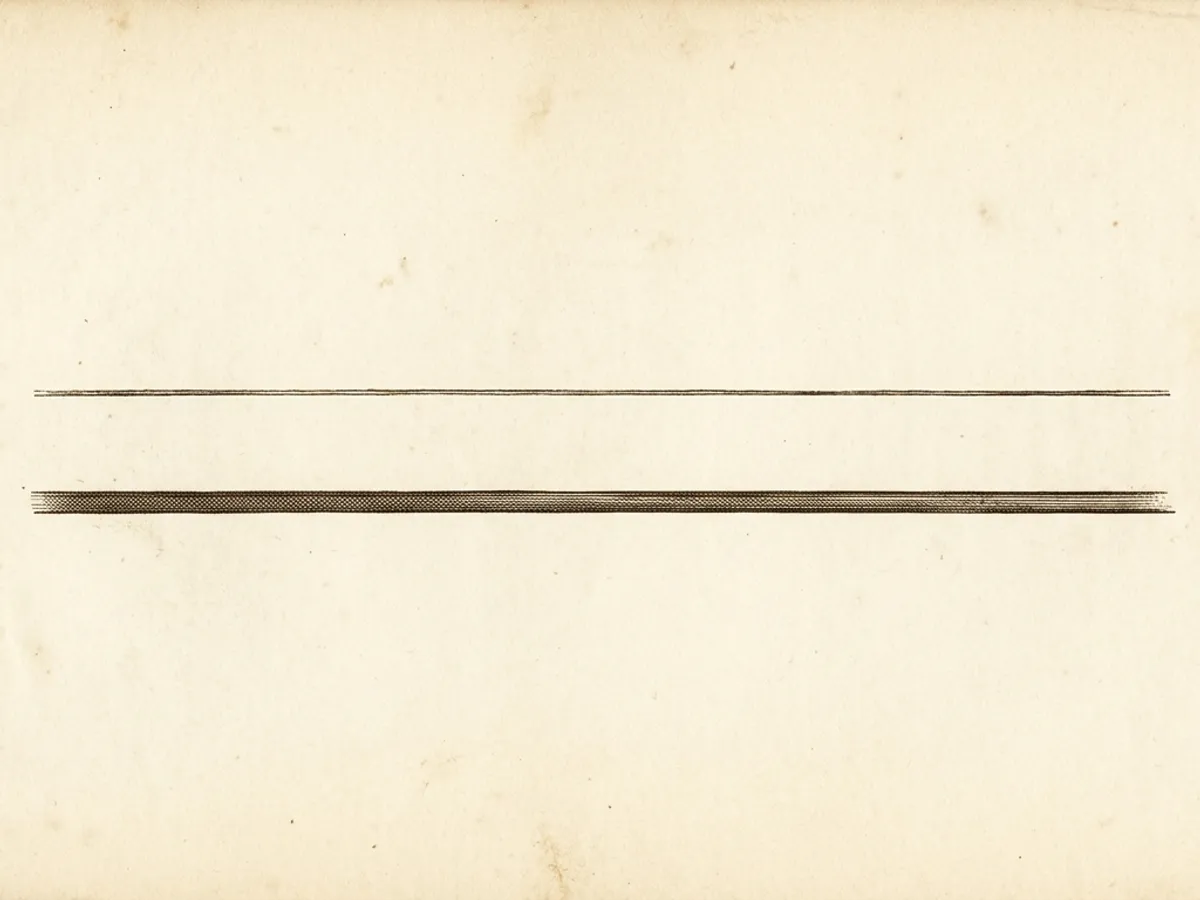
The extra fine designation refers to the tipping ball size at the nib’s tip. This small piece of hard alloy determines the width of the ink line deposited on the page. Extra fine tipping produces a line that typically falls in the range of 0.2 to 0.5 millimeters, depending on the manufacturer — more on that variation below.
Several properties flow directly from the smaller tipping.
Lower ink output per stroke. An extra fine nib deposits less ink on paper per millimeter of writing than a medium or broad. In practical terms, a single cartridge lasts significantly longer in an EF pen than in the same pen fitted with a broad nib. This is economical for high-volume writers. The trade-off is that ink shading — the natural variation in tone as ink dries — and ink sheen are largely invisible at EF widths. If you are choosing fountain pen ink partly for its visual character on the page, a medium or broad nib will show those properties far more effectively.
Sensitivity to paper quality. The smaller tipping makes any surface roughness in the paper more noticeable as feedback through the nib. On cheap copier paper or textured papers, an EF nib can feel scratchy — not because the nib is defective, but because the tipping is encountering the physical texture of the paper surface more acutely than a larger tipping would. Smooth, coated papers eliminate this sensation almost entirely.
Higher manufacturing sensitivity. A well-tuned extra fine nib from a reputable manufacturer is reliable and consistent. A poorly tuned EF nib — one with slightly misaligned tines or an uneven tipping finish — writes worse than a comparable poorly tuned medium, because the tolerances are tighter and there is less margin for error. This is the primary reason to buy EF nibs from established manufacturers rather than unbranded or no-name sources. The pens recommended in this guide have passed this bar reliably.
Light touch. An extra fine nib responds best to a light hand. Pressing down on any fountain pen nib is unnecessary — the ink flows without pressure — but this is most apparent with extra fine nibs, where slight over-pressing can momentarily close the tines and interrupt flow. Learning to write with the nib’s weight making the primary contact with the paper, rather than applying active downward pressure, is the single most effective adjustment for consistent EF performance.
Japanese vs. European Extra Fine: A Critical Distinction
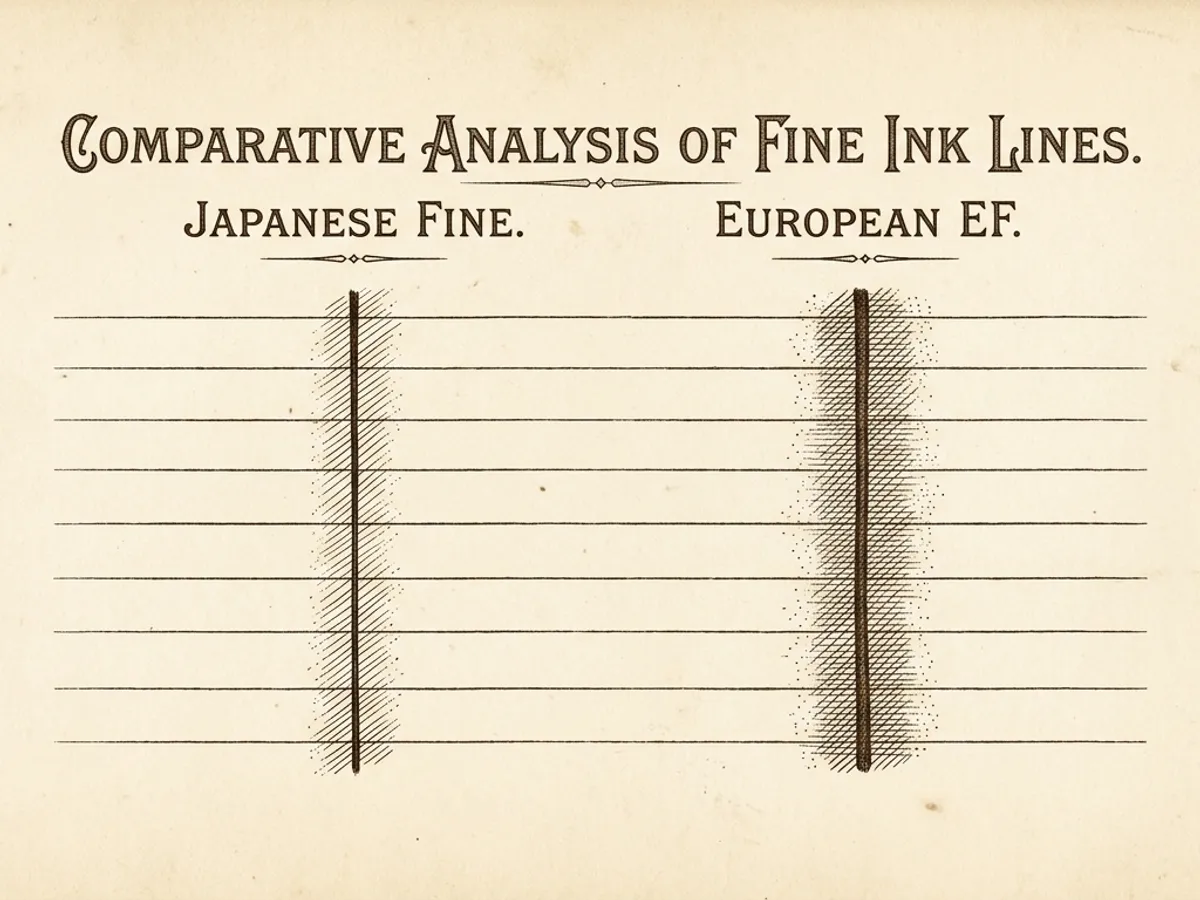
The most practically important fact about extra fine nibs — one that causes consistent confusion among buyers — is that Japanese extra fine nibs and European extra fine nibs are not the same size. They carry similar labels but write at noticeably different widths.
Japanese nibs are calibrated finer across the entire size range. A Japanese fine (F) writes at approximately the width of a European extra fine (EF). A Japanese extra fine, where it exists, is finer still — approaching a hairline width. The difference is rooted in the calligraphic tradition underlying Japanese nib design: Japanese writing requires fine, precise strokes for kanji and kana characters, and Japanese nib manufacturers calibrated their sizing accordingly over generations.
In practical terms:
- A European EF from Lamy, TWSBI, or Kaweco writes at roughly 0.4 to 0.5mm — clean and precise, practical on smooth paper.
- A Japanese Fine from Pilot writes at approximately 0.3mm — finer than most European EF nibs.
- A Platinum Preppy 0.3mm UF (ultra fine) writes at approximately 0.3mm — among the thinnest readily available nib widths from a major manufacturer.
For most everyday writing in English, a European EF or a Japanese Fine is the right target. Hairline-width nibs in the true Japanese EF range are beautiful but demand very smooth paper to perform consistently and are less practical for extended writing sessions.
If you are moving from a European-market pen to a Japanese one and want to maintain the same line width, size up: a Japanese Fine will generally match your European EF experience closely. For a thorough grounding in the nib sizing system and how manufacturers differ, Fountain Pen Nibs Explained covers the full sizing system in depth.
The Best Fountain Pens With Extra Fine Nibs
The pens below are recommended specifically for their extra fine — or equivalent — nib performance. Each has been a consistent recommendation in fountain pen communities over multiple production cycles, not a single batch, but a reliably manufactured product year after year.
Pilot Metropolitan Fine
Pilot does not market the Metropolitan with an “Extra Fine” label in all regions, but the Metropolitan’s Fine (F) nib writes at a width that European writers seeking an EF experience will find closely equivalent. The nib is smooth, consistent, and produced at a scale that makes quality control reliable across production runs.
The brass body gives the Metropolitan a comfortable weight in the hand, and the pen starts readily after being uncapped without needing coaxing. For an EF-width experience paired with Japanese build quality at an accessible price, the Metropolitan Fine is the standard recommendation.
Ink system: Pilot uses its own proprietary cartridges and converters — the CON-40 is a compact squeeze converter, and the CON-70 uses a twist-piston mechanism with greater capacity. Standard international cartridges from other brands do not fit Pilot pens.
View the Pilot Metropolitan on Amazon
Lamy Safari Extra Fine
The Lamy Safari in the Extra Fine size is the most predictable European EF nib at its price level. Lamy’s manufacturing consistency means that the nib you receive closely matches the nib others have described — there is minimal unit-to-unit variation, which matters when buying based on reviews and community recommendations.
The Safari’s nib is user-swappable without tools. If you decide you want to experiment with a different size — fine, medium, or stub — you can buy a replacement Lamy nib and change it in five seconds. The triangular grip section guides the hand into a standard three-finger writing position, which many beginners find helpful and established writers with non-standard grips sometimes find constraining.
Ink system: Lamy uses its proprietary T10 cartridges and Z28 converter. Standard international cartridges are not compatible.
View the Lamy Safari Extra Fine on Amazon
TWSBI Eco Extra Fine
The TWSBI Eco is a piston-fill demonstrator: the entire barrel is transparent, showing the ink level at a glance, and the built-in piston mechanism fills directly from a bottle. There are no cartridges — the piston draws ink directly, and the Eco’s ink capacity is significantly larger than a standard cartridge.
For the extra fine nib specifically, the Eco performs reliably. TWSBI’s nib finishing has improved consistently over the years, and current production models come ready to write without adjustment in most cases. The full pen can be disassembled with the included wrench for deep cleaning — useful for anyone who changes ink colors frequently or maintains several pens in rotation.
The piston fill means you refill from a bottle at a desk rather than anywhere, but the large ink volume reduces how often that is necessary.
View the TWSBI Eco Extra Fine on Amazon
Platinum Preppy 0.3mm Ultra Fine
The Platinum Preppy in the 0.3mm (ultra fine) size produces the thinnest ink line from a major manufacturer at any price point. The UF tipping writes finer than most pens labeled “EF” from other brands, making it the correct choice for anyone seeking the absolute minimum line width — technical drafting applications, extremely compact handwriting, or situations where maximum precision is the priority.
Platinum’s Slip and Seal mechanism creates an airtight cap closure that prevents nib drying even with weeks between uses. For writers who do not write daily, this is a practical advantage over pens that dry out quickly and need to be primed after sitting unused.
The Preppy uses Platinum’s proprietary ink cartridges. The body is lightweight plastic and does not feel premium, but the nib performance exceeds what the price suggests. It is also an effective low-risk way to experience true ultra-fine writing before committing to a more expensive pen.
View the Platinum Preppy on Amazon
Kaweco Sport Extra Fine
The Kaweco Sport in Extra Fine is the compact-carry option. Uncapped, the Sport is short enough for a jeans or jacket pocket; with the cap posted onto the back of the barrel, it extends to a comfortable full writing length. The extra fine nib writes in the European EF range with slightly more feedback than the Lamy Safari’s EF, which is a property of the Kaweco’s smaller nib geometry.
The Kaweco Sport uses standard international cartridges, compatible with Diamine, Caran d’Ache, Faber-Castell, Pelikan, and many other brands. For anyone who wants maximum ink variety with minimum brand restriction from the first day of ownership, this is the practical advantage of the Kaweco system.
View the Kaweco Sport on Amazon
What to Pair With an Extra Fine Nib
The extra fine nib is more context-sensitive than broader sizes. Getting the best performance requires matching it to the right paper and ink.
Paper is the critical variable. On standard copier paper or cheap notebooks, even an excellent EF nib will feel slightly rough and flow inconsistently. On smooth, coated paper, the same nib performs entirely differently — cleanly and without effort. The papers most reliably good with extra fine nibs:
- Rhodia and Clairefontaine are the most widely available, affordable options. Both have a smooth, almost satiny surface that allows the EF nib to glide without any friction or scratching. Available in pads, notebooks, and loose sheets at most pen retailers.
- Leuchtturm1917 is smooth enough for EF nibs and comes in a notebook format that many daily journal writers prefer. It handles most fountain pen inks without significant feathering on the line.
- Tomoe River paper is extremely thin and exceptionally smooth. The combination of an EF nib and Tomoe River paper produces some of the sharpest, most precise lines possible in everyday writing. Available in notebooks from several boutique notebook brands.
- Midori MD Paper handles EF nibs cleanly and is a reliable everyday choice for those who prefer a Japanese paper feel.
Standard office copy paper and cheap composition notebooks are workable for short practice sessions but will underperform relative to what the nib is capable of on better paper. If your EF pen feels scratchy on your usual paper, try it on a Rhodia notepad before concluding the nib is the problem.
Ink choice at fine widths. For extra fine nibs, low-viscosity, well-lubricated inks flow most reliably through the narrow channel. Inks from Diamine, Waterman, and Pilot Iroshizuku are consistently recommended for their clean flow properties and compatibility with all nib sizes. Avoid heavily pigmented inks and iron gall formulations unless the manufacturer explicitly confirms suitability — the narrow channel of an EF nib is more susceptible to partial clogging from inks that leave residue during drying.
Frequently Asked Questions
Is an extra fine nib harder to use than a medium or fine?
Not inherently harder, but less forgiving of poor paper. On smooth paper with a light touch, a well-made EF nib writes as easily as any other size. The main adjustment is learning to reduce downward pressure — fountain pens require less pressure than ballpoints, and EF nibs make this most apparent.
Will an extra fine nib bleed through notebook paper?
EF nibs deliver less ink per stroke than broader sizes, making them the least likely of all nib sizes to cause bleed-through. However, bleed-through is primarily a paper-quality issue, not a nib-size issue. Very thin or absorbent papers will bleed with any nib and any ink. Rhodia and Clairefontaine eliminate this problem entirely.
Do EF nibs work with all fountain pen inks?
EF nibs work with all inks labeled fountain pen safe. The main caveat is that iron gall inks and heavily pigmented inks are harder to clean from narrow channels and may cause partial clogging over time. Standard dye-based inks from Diamine, Waterman, Pilot, and similar brands are safe for long-term use in extra fine nibs. When residue does build up, our Fountain Pen Nib Cleaner guide covers how to clear it.
Can I swap an EF nib onto a pen I already own?
For the Lamy Safari and Al-Star: yes, Lamy sells replacement nibs in all sizes including EF, and they swap without tools. For TWSBI pens, replacement nibs are available from TWSBI directly. Kaweco and Pilot replacement nibs exist but are less commonly swapped in practice. Check your specific model before purchasing a replacement.
Why does my new EF nib feel scratchy?
Three causes cover most cases: rough paper, a factory nib with slightly misaligned tines, or too much downward writing pressure. Try the pen on Rhodia paper first. If the scratching persists on smooth paper with a light touch, the tines may need minor adjustment — a service available from specialist pen retailers and well-documented in fountain pen communities such as r/fountainpens and the Fountain Pen Network.