Updated weekly. The methodical review of fountain pens
Nib & Ink
Reviews · pilot
Vintage scientific plate of a Pilot Kakuno fountain pen, capped and uncapped, showing its hexagonal barrel and hooded nib

Pilot Kakuno Fountain Pen

The Pilot Kakuno delivers Pilot's renowned nib quality in a forgiving hooded design — here's what to expect before you buy.

This site is reader-supported. As an Amazon Associate we earn from qualifying purchases. When you buy through links on this page, we may receive an affiliate commission at no additional cost to you. Our editorial picks are independent of commercial relationships.

Why the Pilot Kakuno Stands Apart

Vintage scientific plate of a Pilot Kakuno fountain pen, capped and uncapped, showing its hexagonal barrel and hooded nib
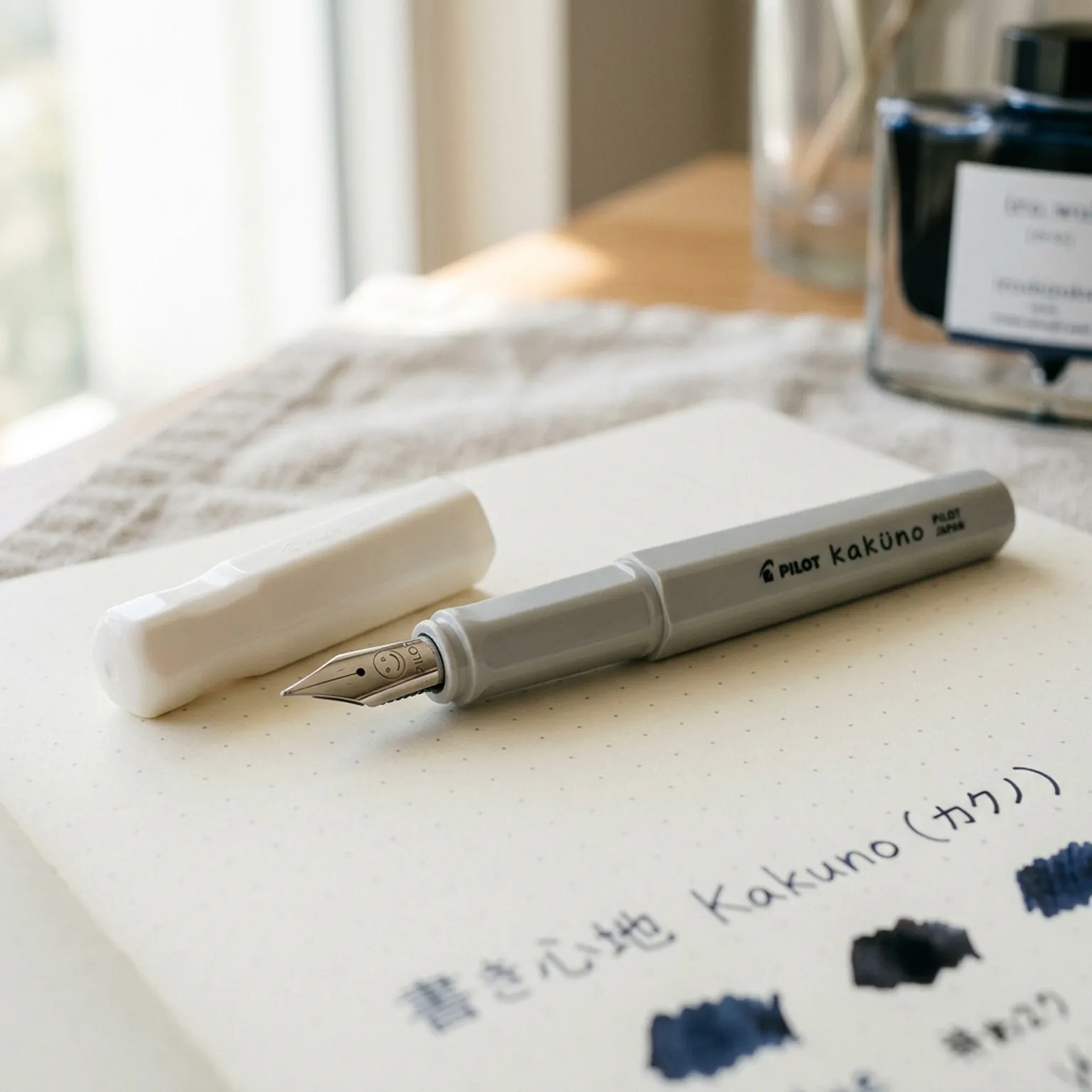
The Kakuno's faceted, clipless body and hooded grip section distinguish it from most exposed-nib entry-level pens.

The Pilot Kakuno is Pilot’s deliberately beginner-friendly fountain pen, and it earns its reputation not through clever marketing but through the writing experience it delivers from the first stroke. Pilot has manufactured fountain pens for decades, and the nib quality and feed design that go into their flagship models filter through to the Kakuno in ways that competing budget pens do not match.

The pen was designed for the Japanese domestic market and initially aimed at younger writers — hence the cheerful smiley face formed by the nib tines — but fountain pen communities outside Japan quickly recognized it as one of the most reliably smooth-writing pens available at any entry-level price point. The design spread to international retail and is now one of the most commonly recommended first fountain pens across fountain pen communities worldwide.

What separates the Kakuno from many entry-level competitors is the hooded nib. On most fountain pens, the nib is fully exposed where it meets the grip section, which means the pen writes reliably only when held within a fairly specific range of angles. The Kakuno’s hooded design partially encloses the nib in a plastic sleeve, leaving only the very tip exposed. This makes the pen significantly more forgiving: it writes consistently across a wider range of grip angles and pressures, which matters enormously for writers who are still developing their fountain pen technique.

View the Pilot Kakuno on Amazon

Nib Design and Writing Performance

Botanical-style engraving of a hooded steel fountain pen nib, showing the tines and stamped dots that form a small face
The hooded steel nib leaves only the tip exposed, and the tines and two stamped dots together form the Kakuno's signature face.

The heart of the Kakuno is its nib, which uses a hooded design that Pilot has refined across multiple pen models over many years. The plastic collar around the nib section does two things: it guides the nib into a consistent orientation against the page, and it slightly reduces exposure to air, which helps the pen start reliably even after sitting uncapped briefly.

The nib tip itself is stainless steel. Pilot tunes the Kakuno to write with a medium-wet flow — enough ink to lay down a consistent, smooth line without flooding or blobbing. The pen starts reliably without requiring pressure, coaxing, or any warm-up routine. Hard starts — where a pen hesitates or skips on the first stroke after sitting capped — are a common complaint with poorly designed or poorly tuned pens at this price. With the Kakuno, the pen is typically writing within the first millimeter of contact with the page.

The smiley face detail is formed naturally by the tines: the two metal prongs that make up the nib tip create a small curved gap that reads as a smile when the nib is held face-up. Pilot added two small stamped dots to complete the expression. It has no effect on writing and will either delight or be irrelevant to you depending on your sensibility.

Understanding Japanese Nib Sizing

Because the Kakuno is a Japanese pen, the nib size labels correspond to Japanese sizing conventions, which run roughly a half-size narrower than the equivalent European labels:

  • Fine (F): In practice, this writes like a European Extra Fine — a narrow, precise line suited to small handwriting, annotations, and narrow-ruled paper. If you write small or prefer tight lines, this is the nib to choose.
  • Medium (M): This is the most popular choice and the nib most commonly recommended as a starting point. It writes like a European Fine — a versatile line that works well on most paper and most handwriting sizes.

In some markets, a Broad (B) nib is also available. Broad nibs produce wide, expressive lines well suited for journaling and correspondence, but they are more sensitive to paper quality — feathering and ink spread become more noticeable on absorbent paper. Fine and medium are the more practical choices for general writing.

If you are switching from a European fountain pen and want to match a similar line width, select one size wider than you ordinarily would.

The Ink System: Cartridges and Converters

Vintage botanical plate of a Pilot proprietary ink cartridge beside CON-40 squeeze and CON-70 piston converters
The Kakuno accepts only Pilot's proprietary cartridges, while the CON-40 and CON-70 converters open it to bottled inks.

The Pilot Kakuno uses Pilot’s proprietary cartridge and converter system, and this is the single most important compatibility point to understand before buying.

Pilot cartridges are not interchangeable with any other brand. The standard international cartridge format — used by Kaweco, Faber-Castell, Pelikan, Diamine, and many other manufacturers — does not fit the Kakuno. Only Pilot-branded cartridges will seat properly and form a correct seal. This is not a severe practical constraint, because Pilot offers cartridges in a wide range of colors and they are widely available. But if you own a collection of non-Pilot cartridges from other brands, those will not work here.

A Pilot converter, purchased separately, threads into the same section and allows the pen to draw ink directly from any bottled fountain pen ink. The CON-40 (a soft squeeze body with a metal collar) and the CON-70 (a piston mechanism with a larger capacity) are both compatible with the Kakuno. A converter is the better long-term investment if you want to explore the breadth of fountain pen inks available, since bottled ink costs substantially less per milliliter than cartridges over time, and you are no longer limited to Pilot’s cartridge range.

When filling from a bottle with a converter, fully immerse the nib section in the ink before operating the converter. This prevents air from being drawn in alongside the ink, which can cause inconsistent flow and early skipping.

The pen ships with a single Pilot cartridge, so it is ready to write immediately after installing the cartridge and allowing a minute for ink to reach the nib tip.

Colors and Nib Sizes

The Kakuno has been produced in a substantial range of body and cap color combinations since its introduction. Common configurations include clear barrels that allow you to see the ink level at a glance, as well as lightly tinted semi-transparent variants and combinations of a pale or neutral barrel with a contrasting colored cap. Colors over the pen’s production run have included clear, smoke, yellow, orange, blue, green, and various two-tone pairings.

Availability varies significantly by retailer and region. Specialty pen retailers tend to carry a broader selection of color variants than general-purpose marketplaces. If a specific color matters to you, it is worth checking multiple sources.

For the writing experience, color is entirely irrelevant — the nib, feed, and writing quality are identical across all color variants at the same nib size. The choice is purely aesthetic.

The transparent and lightly tinted body variants offer a minor practical advantage: ink visibility. Seeing the ink through the barrel gives you advance warning when the cartridge or converter is running low, so you can prepare to refill before the pen runs dry mid-session. For a beginner still learning to monitor their ink supply, this is a genuinely useful feature.

How the Kakuno Compares to Similar Entry-Level Pens

Scientific plate of four entry-level fountain pens in a row: a Pilot Kakuno, Platinum Preppy, Lamy Safari, and Kaweco Perkeo
Each pen occupies a distinct niche: the Kakuno's forgiving hooded nib, the Preppy's sealed cap, the Safari's molded grip, and the Perkeo's faceted form.

The Kakuno occupies a specific position in the entry-level market. It is not the least expensive option available, and it is not the most versatile in terms of ink compatibility. But the nib is consistently one of the smoothest and most reliable in its category, and the hooded design makes it uniquely forgiving.

Versus the Platinum Preppy. The Preppy costs less and is available in extremely fine nib sizes — particularly its 0.3mm extra-fine — that have no peer at the budget price point. Its cap uses Platinum’s Slip and Seal inner mechanism, which keeps the nib from drying out during extended idle periods: a Preppy set aside for days or weeks typically restarts without difficulty. The Kakuno handles shorter idle times equally well thanks to its hooded nib, but for pens that sit unused for long stretches, the Preppy’s cap seal is a meaningful advantage. Both pens use proprietary ink systems, but they are different proprietary systems — Pilot cartridges and converters are not interchangeable with Platinum ones.

Versus the Pilot Metropolitan. The Metropolitan is the natural step up within the Pilot line. It has a brass barrel that gives it noticeably more weight and a more substantial feel in the hand. The Metropolitan uses an exposed nib rather than hooded, which requires a slightly more consistent grip angle but suits writers who prefer a traditional pen profile. Both pens share the same Pilot cartridge and converter system, so moving between them involves no change in ink compatibility. A full breakdown of the Metropolitan’s features is available in the Pilot Metropolitan review.

Versus the Kaweco Sport. The Sport is a compact pocket pen that pops open to full writing length when the cap is posted. Its greatest practical advantage over the Kakuno is ink system breadth: it uses standard international cartridges, giving immediate access to a wide range of inks from Diamine, Pelikan, Faber-Castell, and many other brands without a converter. The nib is good but somewhat less consistently tuned than the Kakuno across units. The Sport’s form factor — very compact when capped — suits small pockets and bags in a way the Kakuno does not.

Getting Started with Your Kakuno

When your Kakuno arrives, it needs a cartridge installed before it can write. Take the included cartridge and press it firmly onto the pen section until you feel it seat with a distinct click or pop — this punctures the cartridge seal and allows ink to flow toward the tip. Hold the pen nib-down and let it sit for two to three minutes to allow gravity to draw ink through the feed channels to the nib.

Try writing on a piece of scrap paper first. The first few strokes may be faint while the feed wets fully. If the pen does not start writing after a minute of waiting, recap it nib-down for a further five minutes, or tap the capped pen gently nib-down on a flat surface several times. A cartridge that did not seat fully is the most common cause of a new pen that will not write, and pressing it more firmly into place usually resolves it.

Paper Makes a Real Difference

The Kakuno’s medium nib is tolerant across a wide range of paper, but it performs noticeably better on paper designed for fountain pen ink. Standard copy paper and many inexpensive notebooks are highly absorbent — fountain pen ink spreads along the fibers, causing feathering and bleed-through, and the nib can catch on loose surface fibers, producing a scratchy sensation. Rhodia pads, Leuchtturm1917 notebooks, and Midori MD paper are all affordable and widely available options that substantially improve the writing experience. If your pen feels rough or the lines look fuzzy on first use, try better paper before making any other adjustments.

Cleaning

Flush the Kakuno with cool running water when you change inks. Remove the cartridge, hold the section under a gentle stream, and let water flow through the feed until it runs clear. For a converter, draw in water and expel it several times. A thorough flush every few months even if you are not changing colors keeps the feed channels clear. For a full walkthrough of filling and flushing, see How to Fill a Fountain Pen With Ink.

Frequently Asked Questions

Is the Pilot Kakuno a good first fountain pen?

It is among the best options at its price. The hooded nib is more forgiving of inconsistent grip angle than most exposed nibs in this category, the factory tuning is consistently reliable, and the pen starts easily. The design is lighthearted but the writing quality is serious.

Can I use any fountain pen ink in the Kakuno?

With a Pilot converter installed, any bottled ink labeled fountain pen safe will work. Without a converter, you are limited to Pilot-branded cartridges. Standard international cartridges from Kaweco, Diamine, Pelikan, and other brands will not fit.

What is the smiley face on the nib?

The tines — the two metal prongs forming the nib tip — create a small curved gap that reads as a smile when the nib is held face-up. Pilot stamped two small dots near the base to complete the face. It has no effect on writing and is purely decorative.

The pen came with ink on the nib. Is that normal?

Yes. Pilot tests every Kakuno before packaging, which often leaves trace amounts of ink on the nib. The pen can be used immediately; the test ink is standard Pilot fountain pen ink.

My Kakuno does not start reliably after sitting capped overnight. What should I do?

First check that the cap is fully and firmly closed — a cap that is not completely seated allows the nib to dry faster. If the cap is properly sealed and hard starts persist, a thorough flush with cool water and a fresh cartridge resolves most cases. Persistent hard starts on a pen that was previously writing well usually indicate dried ink residue in the feed channels that needs to be cleared.

Is the Kakuno suitable for left-handed writers?

Yes. The hooded nib is actually particularly well suited to left-handed writers because it tolerates a wider range of angles, including the underhand grip that some left-handed writers use. The main consideration for left-handed writers is ink drying time — fast-drying inks help avoid smearing on the hand following the nib. A full guide to fountain pens for left-handed writers is available on the site.